Friday, August 19, 2005

BBC NEWS | South Asia | Nepal rebels 'killed' in clashes

King Gyanendra
Violence has increased since
King Gyanendra assumed direct control


Government troops in Nepal have killed six Maoist rebels in clashes in a western district which left a soldier injured, officials say.

The clashes are said to have occurred during a search for rebels who took part in a deadly attack on an army camp in a neighbouring district last week.

At least 70 soldiers and rebels were killed in the clash.

It was some of the bloodiest fighting since King Gyanendra seized direct control of power in February.

In a separate incident, suspected rebels set off a home-made bomb in the residential complex of a royal adviser, Sachit Shumsher Rana, in the capital, Kathmandu.

The bomb caused minor damage and no has been hurt.

Clashes between rebels and government troops have increased since King Gyanendra assumed direct control of the country in February, saying politicians had failed to tackle the insurgency.

The clash earlier this week provoked the United States to warn Nepal's king to return the country to democracy or face a slide towards chaos.

About 12,000 people have died in the 10-year Maoist campaign which is aimed at replacing the monarchy with a communist republic. Sphere: Related Content

Thursday, August 18, 2005

Xinhua - English | Nepalese FM criticizes Western media's untrue report about Nepal

www.chinaview.cn 2005-08-17 23:47:00

BEIJING, Aug. 17 (Xinhuanet) -- Nepalese Foreign Minister Ramesh Nath Pandey here Wednesday criticized some Western media's untrue report about Nepal, saying it has done harm to Nepal's investment environment.

Pandey made the remarks in his meeting with some Chinese entrepreneurs.He said the untrue report caused worry among potential investors about Nepal's business environment and security.

The fact is, Nepal has great potential for business, he said. Chinese companies can invest in Nepal's water and electricity resources, which can not only meet Nepal's domestic demands but also be exported to countries such as India and Bangladesh.

Besides, Nepal is rich in tourism resources, Pandey said, adding that his government welcomes both Chinese tourists and explorers of tourism resources.

He said that two air routes have been set up between Nepal and China, namely the one between Katmandu, capital of Nepal, and Shanghai, and the other one between Katmandu and Lhasa. He hopes the two countries will open more air routes between Katmandu and other Chinese cities at an early date, so as to promote bilateral cooperation in politics, economy and other fields.

"The Nepalese government will exert efforts to improve investment environment and protect Chinese businessmen's interestsin Nepal." Pandey said.

Pandey arrived here Sunday for an official visit as guest of Chinese Foreign Minister Li Zhaoxing. Enditem">Xinhua - English: "Nepalese FM criticizes Western media's untrue report about Nepal
www.chinaview.cn 2005-08-17 23:47:00

BEIJING, Aug. 17 (Xinhuanet) -- Nepalese Foreign Minister Ramesh Nath Pandey here Wednesday criticized some Western media's untrue report about Nepal, saying it has done harm to Nepal's investment environment.

Pandey made the remarks in his meeting with some Chinese entrepreneurs.He said the untrue report caused worry among potential investors about Nepal's business environment and security.

The fact is, Nepal has great potential for business, he said. Chinese companies can invest in Nepal's water and electricity resources, which can not only meet Nepal's domestic demands but also be exported to countries such as India and Bangladesh.

Besides, Nepal is rich in tourism resources, Pandey said, adding that his government welcomes both Chinese tourists and explorers of tourism resources.

He said that two air routes have been set up between Nepal and China, namely the one between Katmandu, capital of Nepal, and Shanghai, and the other one between Katmandu and Lhasa. He hopes the two countries will open more air routes between Katmandu and other Chinese cities at an early date, so as to promote bilateral cooperation in politics, economy and other fields.

'The Nepalese government will exert efforts to improve investment environment and protect Chinese businessmen's interestsin Nepal.' Pandey said.

Pandey arrived here Sunday for an official visit as guest of Chinese Foreign Minister Li Zhaoxing. Enditem" Sphere: Related Content

Wednesday, August 17, 2005

Nepal rejects claim that French helicopter landed on top of Everest

17 August 2005 04:18

By Daniel Howden

Mountaineers in trouble high on Everest cannot expect rescue by air after the Nepalese government dismissed claims by Eurocopter that it had landed a helicopter on the summit.

Kathmandu has said it will report the French Eurocopter firm to the international aviation bodies after an investigation by the Civil Aviation Authority of Nepal (CAAN) concluded the Eurocopter story was false.

The French aviation firm claimed a world first in May, saying its aircraft had executed a successful landing and take-off from the 29,000ft peak of Everest. The Nepalese authorities said they had granted permission to Eurocopter to perform a test flight around Everest this year in the hope of getting positive publicity for the possibility of higher-altitude rescues. But they cited a written statement by the pilot, Didier Delsalle, saying that the helicopter had made an emergency landing a kilometre beneath the summit, at the South Col, due to bad weather. The French firm has yet to respond to the allegations that it had violated aviation guidelines.

Eurocopter's claims, made at a press conference in Paris, were taken so seriously that the support crew for the Slovenian climber Tomaz Humar, who was trapped for four days on the dangerous, unconquered Rupal face of the Himalayan mountain Nanga Parbat this month, considered delaying rescue attempts so the French aircraft could be brought in.

The climber was eventually plucked from a ledge on the ice wall at an altitude of about 20,000ft by a Pakistani army Lama helicopter in what is believed to be the highest rescue of its kind.

The number of climbers trying to reach the summit of Everest has risen sharply in recent years, with a consequent rise in the number of fatalities. Nearly 200 people have died on its slopes, with an average of 60 expeditions a year attempting the climb. Sphere: Related Content

Tuesday, August 16, 2005

China pledges $12.3 million aid to Nepal: South Asia : Hindustan Times.com

Kathmandu, August 16, 2005|11:19 IST

China has pledged to bail out cash-strapped Nepal with an additional aid of $12.3 million, a rare gesture by Beijing that has no strings attached.

The agreement signed in Beijing between Chinese Foreign Minister Li Zhaoxing and his Nepalese counterpart Ramesh Nath Pandey is an additional string in the cap of the latter who is on a 11-day visit to China at the invitation of the Chinese government.

The aid comes in addition to the Nepalese Rs 800 million Beijing has committed to Nepal as annual development assistance and which can be used in any area Kathmandu wants, from buying arms to paying civil servants' salaries.

It comes at a time when the cash-strapped government headed by King Gyanendra is looking at an over 60 per cent increase in donor aid to meet its nearly Rs 15 billion budget deficit this fiscal.

On August 13, as Nepal celebrated the 50th year of the establishment of diplomatic ties with China, King Gyanendra called Beijing the kingdom's 'all weather friend'.

The new aid will further cement ties between Nepal and its northern neighbour even as its relations with its southern neighbour India deteriorated further this month with the Royal Nepalese Army blaming Indian guns for its battle reverses with the Maoist guerrillas and New Delhi rebutting the allegation.

Both China and Nepal have also agreed to mutually waive visas for diplomats and government officials and allow multiple visas to businessmen. Currently, that is a friendship measure existing between India and Nepal. Nepalese need no visa or passport for going to India and residing there and vice versa.

China also agreed to allow Nepal to use its Tibet highway. With the Maoist insurgents often blocking highways in remote districts, Nepal's northernmost districts like Jumla and Humla, which lie next to the Tibetan border, face scarcity of food and essential goods.

According to the agreement with Beijing, now supplies can go from Kathmandu to Khasa on Nepal's side of the border, cross into Tibet and from there follow the Tibetan highway to reach Nepal's northern districts.

Besides the aid, China also made what is being seen as a symbolic gesture to show it was supporting King Gyanendra's government at a time several donor countries have distanced themselves from the regime.

Chinese President Hu Jintao, who generally meets only visiting heads of state and the most powerful dignitaries like the US Secretary of State, on Tuesday met the Nepalese Foreign Minister to discuss bilateral issues. Sphere: Related Content

Saturday, August 13, 2005

Security forces kill 20 Maoists in Nepal: South Asia : Hindustan Times.com

Kathmandu, August 13, 2005|17:40 IST

Stepping up their anti-insurgency operation, Nepalese security forces have gunned down 20 Maoists after a rebel attack left one soldier dead and five injured in the southwest Nawalparasi district.

The incident occurred on Friday when the security forces were clearing obstacles placed by the Maoists in Chormara and Arunkhola areas along the highway in Nawalparasi, state-run The Rising Nepal reported, quoting security sources.

The troops were first attacked by the rebels who killed one soldier and injured five others. Retaliating, the security forces shot dead 20 rebels, the report said.

Meanwhile, 5,000 students have been deprived of their studies after the closure of 35 schools following the Maoist attack in Pilli area of Kalikot district, where 43 security personnel and 26 rebels were killed last week.

More than 400 children have been killed and over 20,000 displaced since the Maoists launched insurgency in 1996.

The European Union has expressed concern over the affect of the armed conflict on the Nepalese children.

Calling on the rebels to keep children out of the armed conflict, the EU has asked the government in a statement to ensure safety of the children and stressed for their rehabilitation." Sphere: Related Content

Friday, August 12, 2005

Security Situation Worsens in Nepal - Los Angeles Times

1:12 AM PDT, August 12, 2005

By BINAJ GURUBACHARYA, Associated Press Writer

KATMANDU, Nepal -- The rebel victory appears to have been as unexpected as it was complete -- a battlefield win that has exposed the military weakness of Nepal's army and the political vulnerability of King Gyanendra's royal dictatorship.

Details of the assault are scant, but this much is known: the insurgents overran about 200 troops camped on a remote mountainside. At least 40 of the soldiers may have been executed. Dozens appear to have fled.

Days after Sunday's attack, the rebels' first major victory in months, the army has retaken the area around Tilli, about 340 miles northwest of Katmandu, and rescued some of the troops who fled. But the rebels say they are holding 50 soldiers prisoner, and even Nepalis who support the king say the attack was alarming.

"The king was the last hope for most of us, but if attacks like this continue there will be no future for Nepal," said Sharad Thapa, a government worker in the capital. "This is just terrible."

King Gyanendra seized power Feb. 1, saying that dismissing the democratically elected government and taking the reins himself was the only way to quash the insurgency. Nearly 12,000 people have been killed since the start of the rebellion in 1996.

The coup was condemned internationally, and major allies Britain, India and the United States suspended military aid.

At home, Nepalis were split -- there were a few ardent supporters of the stumbling politicians who King Gyanendra had usurped, but many people also distrusted the king.

Militarily, the king's move has produced mixed results. Attacks have dropped in larger towns, but little has changed in the countryside, where the rebels remain in control of large swaths of territory.

Sunday's attack, analysts and opposition leaders say, could seriously weaken the king.

Inderjit Rai, an independent political analyst in Katmandu, called it "a major blow to the government."

"It proves the security situation is still vulnerable in much of the country," he said. "If the government fails to take control of the security situation then they lose support from all the people."

"The attack has proved the king's claim of improved security to be nothing but hollow," said Ram Sharan Mahat of the Nepali Congress, the country's largest party.

The rebel leader who claims to have led the attack, a man known only as Prabhakar, said on the insurgent's Web site that the victory had "shaken the enemy," and proved that the guerillas could defeat the government on any battlefield. He said 26 rebel fighters were killed in the fighting.

The rebels have a strong presence across much of rural Nepal, particularly in areas where there are few military outposts, and they control much of the isolated mountainous region in the Himalayan nation's northwest and midwest.

While they are believed to have about 20,000 fighters, few observers believe they could defeat the king and take control of the nation.

So far, the king's main political opposition comes from political parties pressing to get back into power -- and not a popular movement like the one that forced the previous king, in 1990, to establish a democracy.

Some observers warn, however, that the incessant fighting between the palace and the political parties gives strength to the rebels.

The U.S. Ambassador to Nepal, James Moriarty, said Tuesday that "the continuing divisions between the Palace and the political parties aid only the Maoists and their plans to turn Nepal into a brutal and anachronistic state."

"The people want reconciliation. They want peace. The way to achieve peace is with a democratic government united against the Maoist assault on Nepal," he said. Sphere: Related Content

Thursday, August 11, 2005

Xinhua - English | 10 more bodies of security personnel discovered in Nepal

KATHMANDU, Aug. 10 (Xinhuanet) -- Nepali security forces said Wednesday they have discovered 10 more bodies of security personnel killed in the overnight battle with the anti-government guerrillas at the Pili base camp in mid-western Nepal on Sunday. With this, the total number of security personnel killed in the clashes at Pili has reached 50.

On Sunday evening, the guerrillas launched an offensive against the security forces stationed at the Pili base camp in Pakha village, the headquarters of Kalikot district, some 700 km west of Kathmandu, Royal Nepalese Army's Directorate of Public Relation said in a statement.

Over 50 soldiers were taken under control by the guerrillas following the overnight clashes, and Chairman of the Nepali anti-government guerrillas Prachanda Wednesday assured of releasing all the captive soldiers.

A senior guerrilla leader Prabhaker admitted that 22 guerrillas were killed and 45 others injured during the clashes. More than 1,200 additional troops who were deployed from neighboring districts on Monday reached the clash site on Tuesday morning, RNA noted.

Security forces on Tuesday cordoned off entry points of Bajura, Jumla and Dailekh districts to hunt for the guerrillas and more troops have been mobilized at the clash site, according to RNA. Some 200 security personnel were stationed at the base camp at Pakha village established a month ago for the construction of the Surkhet-Jumla road section of the Karnali Highway." Sphere: Related Content

Wednesday, August 10, 2005

Nepal attack exposes Gyanendra

Despite the King’s pledge of maintaining peace and security in the country, the law and order situation is turning from bad to worse except in Kathmandu

THE killing of at least 40 Nepalese soldiers in the deadliest attack since King Gyanendra seized power in February has exposed his pledge to put down a violent Maoist rebellion, analysts said on Wednesday.

The soldiers were lined up and shot in the head after an attack on an army camp near the northwestern town of Kalikot, according to the army, which said another 75 servicemen are missing. The rebels say 26 of their fighters were killed.

It was the worst incident since the Maoists, whose battle for a communist republic has claimed 12,000 lives in the past nine years, killed 36 people by bombing a crowded bus in June.“Excepting for Kathmandu, the Maoists are showing their muscle everywhere,” said Mahendra Prasad Bhusan, political professor at Tribhuvan University here.

“They have challenged the army by attacking (their camp),” he added, referring to Sunday’s assault.

Gyanendra sacked a four-party coalition government on February 1, pledging to restore security and improve services in the impoverished Himalayan kingdom.

The move drew sharp condemnation from around the world and isolated Nepal diplomatically, with India, Britain and the United States reviewing supplies of military and humanitarian aid.

US ambassador James Moriarty warned on Tuesday that Nepal risked sliding into chaos unless the king re-establishes democracy and restores civil rights.

“Unless the principles of freedom, civil rights, and democracy once again take root through a process of true reconciliation among the legitimate political forces, I fear Nepal will inexorably slide towards confrontation, confusion and chaos,” Moriarty said.

“The continuing divisions between the royal palace and the political parties aid only the Maoist rebels and their plan to turn Nepal into a brutal and anachronistic state.”

Bhusan said Gyanendra had not made good on his promises and that the Maoists looked stronger than ever. He warned the monarchy itself was at risk and that Nepal was in danger of becoming a failed state.

“If the King does not reform his policy and establish democracy, it may create a grave situation. (He) has to act seriously and thoughtfully otherwise a situation will evolve in Nepal which may sweep away the monarchy itself,” Bhusan said.

Political analyst and professor Lok Raj Baral also believes security is deteriorating in the Hindu kingdom.

“Despite the king’s pledge of maintaining peace and security in the country, (the) law and order situation is turning from bad to worse except in Kathmandu,” Baral told AFP earlier this month.

President of the human rights group Informal Sector Service Centre (INSEC) Subodh Raj Pyakurel said Gyanendra had failed in every aspect since he took over the administration.

“The law and order situation in the country has been very badly affected as the Maoists have begun to spread everywhere, showing their muscles,” Pyakurel said.

“It seems the Maoists are in (even) stronger position after attacking the security men at Kalikot,” he said.

The Maoist attack came after Gyanendra’s recent claim that the insurgency had been curtailed. Information and Communications Minister Tanka Dhakal said just days ago that the Maoists would soon be “crushed”.

“The position of security has been strengthened and Maoists have been weakened and are in process of being crushed soon,” he said.

More than six months after the king took power, pro-democracy protests continue almost daily, Nepal’s once vibrant media remains under stringent censorship and political opponents including the deposed prime minister are in jail. “The people’s human rights have been grossly violated, the people’s insecurity is increasing, the health services, education and national economy have been badly affected,” Pyakurel said. “These developments have forced the people to lose confidence in the state as the king is not doing what he commented publicly,” he said. Sphere: Related Content

Tuesday, August 09, 2005

Nepal's Human Rights Record Threatens Military Aid - New York Times


Desmond Boylan/Reuters
King Gyanendra seized absolute power in Katmandu in order,
he said, to fight the country's Maoist insurgency.

Nepal's Human Rights Record Threatens Military Aid

By SOMINI SENGUPTA
Published: August 9, 2005

KATMANDU, Nepal, Aug. 5 - When a firebrand student leader went to visit his friends in jail here last week, he, too, found himself arrested by the police and locked up on a charge of sedition.

Antigovernment protests in Katmandu have grown more strident recently, with students stoning the police and demanding the king's ouster.

King Gyanendra seized absolute power in Katmandu in order, he said, to fight the country's Maoist insurgency.

When a political prisoner was freed by a court order in the town of Nepalganj in June, plainclothes police officers immediately plucked him from the courthouse steps.

And after two Nepalese newspaper journalists wrote last month about the army's deploying children as informers against suspected Maoist guerrillas, they were summoned to the army barracks for questioning.

Such incidents are not only measures of life and law in a country squeezed between its all-powerful Hindu king and the nine-year-long Maoist insurgency he has failed to quell. They are also of creeping importance to American lawmakers.

Before a new round of American military aid can start flowing to this troubled Himalayan kingdom, Congress has said it must be convinced that Nepal's ruler, King Gyanendra, can guarantee basic human rights. The Bush administration can override that condition if it determines that there is a national security imperative for Nepal to get the aid.

An administration decision is expected in the coming weeks, and whichever way the president goes is likely to be read throughout this region as an important barometer of White House priorities.

Nepal has functioned as an absolute monarchy since October 2002, when King Gyanendra dismissed the elected government on the ground that it had proved ineffective and corrupt. Last Feb. 1, he ratcheted his control up another notch, imposing emergency rule, arresting hundreds of political party members and suspending press and civil liberties.

Emergency rule has since been lifted, but many restrictions remain. This week, for instance, the government demanded to know why news broadcasts had resumed on a private FM radio station, in contravention of the Feb. 1 order.

The measures have proved increasingly unpopular. In Katmandu, the capital, what began as mild protests against the Feb. 1 royal decree have become more violent and outspoken. In recent weeks stone-throwing student demonstrators who call openly for the overthrow of the monarchy have tussled regularly with police officers wearing blue fatigues and carrying riot shields.

Chants during the protests have turned strikingly audacious. "Gyanay Chor, Desh Chhod," goes one popular cry. Using a diminutive form of his name, it calls the king a thief and urges him to leave.

Despite the Feb. 1 order, journalists frequently defy the curbs against independent reporting on the conflict. Political cartoons take pot shots at the king.

"People hoped and believed he had a plan," Kanak Mani Dixit, one of the country's most respected journalists, said in an interview here. "I said he has made a major mistake, but he will be forgiven if he has a plan. But nothing has happened." The king's latest steps were controversial even beyond Nepal and have been accompanied by what his critics see as a steady deterioration of civil liberties as the king struggles to turn back a widening insurgency that has fed off this country's poverty and caste divisions.

The American law threatening the loss of military aid, passed by the United States Congress last year, was prompted by Nepal's unenviable human rights distinction: during the past two years, the largest number of new cases of disappeared persons reported to the United Nations came from here.

Some of the missing reappear after courts take up habeas corpus petitions; those who are suspected of being Maoists or their sympathizers can be locked away without charges for up to a year under Nepal's antiterror laws.

The conditions for restoring full American military aid range from whether law enforcement authorities obey court orders on prisoner releases, to whether steps are taken to end torture by security forces, to whether the government allows the National Human Rights Commission to function freely.

Neither the United States Embassy here in Katmandu nor officials at the State Department in Washington agreed to comment on the record about whether Nepal had sufficiently complied with those conditions. In the past, American officials have urged the king to reconcile his differences with the political parties and take steps to return to democracy.

Before dispatching new aid, Congress has said it must be convinced that Nepal's ruler can guarantee basic human rights. Sphere: Related Content

Sunday, August 07, 2005

HoustonChronicle.com - Political crisis, fear grip Nepal

Five months after a coup, the king is no closer to a deal with rebels or political parties
By TERRY FRIEL
Reuters News Service

KATMANDU - It's an hour before midnight and the Go Go Bar is packed with the boisterous sons of Nepal's new middle class stuffing cash into dancers' panties.

Katmandu is humming, its young people spending big on drugs, disco and drink.

But while the capital parties, Nepal is paralyzed by a political crisis and an increasingly bloody Maoist rebellion aiming to oust King Gyanendra, who seized power in February, ending 15 years of democracy.

'Nobody knows what will happen — a kind of terror still exists,' says human rights campaigner Krishna Pahadi, freed this month after being held for 143 days in a police camp. 'There is a climate of fear. The rule of law is totally demolished.'

Gyanendra said he was forced to take over because the politicians were incapable of quelling the Maoists' 'People's War,' which has killed at least 12,500 people since 1996. But five months on, he is no closer to a deal with the guerrillas or with the seven mainstream political parties.

The political parties are slowly forming a united front and appear to be moving closer to the Maoists.

'The two (parties and rebels) coming together would build up pressure on the king,' says S.D. Muni, a South Asia expert at New Delhi's Jawaharlal Nehru University. 'Either he makes compromises, or if he does not, then I think Nepal will see a lot of turmoil in coming years.'

But analysts expect no real breakthrough for at least three to four months, when the parties can organize protests after the monsoon and crop-sowing season. The parties have so far failed to rally popular support against the king, despite his increasing unpopularity.

Even before the Feb. 1 royal coup, the Hindu kingdom, one of the world's poorest nations had seen remarkable political instability, with 14 prime ministers in under 15 years.

In fact, for hundreds of years, it has seen bizarre power plays, murder, exile and takeovers between royalty and the upper caste Brahmins and Chettriyas who dominate the still largely feudal country.

Parliament has been dissolved since 2002, when Nepal was supposed to prepare for elections. Gyanendra sacked Prime Minister Sher Bahadur Deuba for failing to hold them.

The palace says Gyanendra is popular and adored, but many Nepalis are suspicious of the way he came to power, after his brother, King Birendra, and several other members of the royal family were gunned down by the then-crown prince in 2001. Sphere: Related Content

Thursday, August 04, 2005

Top News Article | Reuters.com | Family searches for Texan hiker missing in Nepal

Thu Aug 4, 2005 7:26 AM ET
By Gopal Sharma

KATHMANDU (Reuters) - The family of a 25-year-old American hiker missing in Nepal for two weeks stepped up their search for him around Mount Everest Thursday after making an emotional appeal for information.

Trevor Stokol went missing on July 22 while trekking near Everest base camp. Thursday, a helicopter will make a second aerial search of the area, and drop supplies for a team of trackers led by an Australian search and rescue expert.

'We have not given up hope. We need your help,' his father, Arnold Stokol, told reporters Wednesday.

Members of the Stokol family came to Nepal to coordinate the search after being told by the U.S. Embassy in Kathmandu that he had disappeared.

So far the search party has found no trace of Trevor in the beautiful but rugged Khumbhu region, where the 8,850-meter (29,035 feet) summit of Everest is located.

Arnold, an optician from Dallas, Texas, appealed to locals, to keep an eye out for their son.

Trevor, who was on the final leg of an eight-month tour of South and Southeast Asia before going to medical school in Dallas, had phoned his family before setting off for the 5,350 meter (17,650 feet) Everest base camp.

'He was extremely, extremely excited about the final leg of his trip and returning to his family and dog,' said the 53-year-old Arnold, holding photographs showing his son with curly brown hair and a full beard.

Every year thousands of foreigners visit Nepal, home to eight of the world's 14 highest mountains. A total of 185 mountaineers have died on the slopes of Mount Everest, the world's tallest peak.

Arnold said his son, an enthusiastic photographer, was extremely strong, tenacious and had excellent survival skills.

'It is possible that he got disoriented as a result of altitude sickness or hypothermia and has wandered down the valley,' he said.

"It is also possible that he is injured and immobilized at any location, either near the area where he was last seen or further down the mountain."

Trevor was carrying a camera, some snack food and a bottle of water when he went missing after leaving his hiking companion behind.

Arnold said he thought it unlikely that Maoist guerrillas, active throughout the Nepali countryside, had abducted his son. Maoists do collect money from foreign trekkers as "tax" but have so far not harmed or captured any foreign tourists.

Arnold said a fund had been set up in the United States to help pay for the search. Sphere: Related Content

Tuesday, August 02, 2005

Saving Nepal's Rhinos, One Truckload at a Time

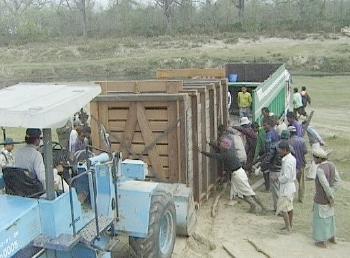
Captured and tranquilized rhino in a wooden cage
(Photo courtesy Dhruba Basnet)


By Deepak Gajurel

KATHMANDU, Nepal, August 2, 2005 (ENS) - A darting expert shoots a male rhino and the two ton animal falls unconscious in Nepal's Royal Chitwan National Park. A dozen people hoist the sleeping rhino onto a sledge and then into a wooden cage fitted on a truck.

The process goes on until the desired number of rhinos is captured and the trucks head for Royal Bardia National Park and Royal Shuklaphanta Wildlife Reserve in western Nepal.

The Asian one-horned rhino is a critically endangered species, and Nepal has second largest herd in the world. Rhino conservation is not an easy task, and translocation of the animals to populate another park is regarded as one of the best options to sustain the rhino population.

More than 100 experts, technicians and wildlife workers are engaged in the operation. A dozen domesticated elephants are used to comb the grasslands in Royal Chitwan National Park. From dawn to dusk the elephants and their human companions search for rhinos, combing the grasslands where grasses and weeds stand up to 10 meter (33 foot) high.

When rhinos are sighted, the workers drive them towards safe land for darting. Experts dart them, take necessary measurements of the unconscious rhinos, put them in a cage and then onto a truck, and transport them to a new destination for release into the wild.

Translocation of the rhinos to Bardia has helped reduce pressure on habitat in Royal Chitwan National Park, a UNESCO World Heritage Site. This will decrease the possibility of potentially damaging human-rhino conflicts that arise when foraging rhinos stray into farmlands surrounding the park, say officials at the Department of National Parks and Wildlife Conservation.

Establishing new viable rhino populations in Royal Bardia National Park and Royal Suklaphanta Wildlife Reserve is the main goal of the rhino translocation.

"It is important to conserve the endangered species from any natural and other disasters by developing viable populations in Royal Bardia National Park and Royal Shuklaphanta Wildlife Reserve," says Narayan Sharma Paudel, deputy director of the Department of National Parks and Wildlife Conservation (DNPWC).

Repeated incidents of rhino-human conflict pressured officials and conservationists to brainstorm a sustainable solution. Translocation of rhinos was one of the answers.

The Department of National Parks and Wildlife Conservation is supported by WWF Nepal program for the costly process of rhino translocation. "We have been providing technical as well as financial supports for rhino translocation,"says Dr. Chandra Prasad Gurung, WWF Nepal country representative.

Captured and tranquilized rhino in a wooden cage
(Photo courtesy Dhruba Basnet)

Nepal is planning to translocate more rhinos from Chitwan to Bardia this year, DNPWC officials say, because past translocations have been successful.

"From the suitability point of view, rhinos taken to Royal Bardia National Park earlier have already given birth. This has proven that they can live there sustainably," says Dr. Mukesh Chalise, professor of biology at Tribhuwan University .

The translocation could have continental as well as global significance. In 1998, the Asian Rhino Action Plan emphasized preservation and increase in the number of animals and sanctuaries wherever possible.

Nepal's rhino conservation efforts have been applauded abroad. DNPWC officials say that the Asian Rhino Specialists Group's meeting held in Indian State of Assam in 1999 praised Nepal for rhino conservation efforts and encourage maintainance of viable rhino populations in their old habitats as well as the new ones.

A founding population of 13 rhinos was introduced from Royal Chitwan National Park to Royal Bardia National Park in 1986. Most of the translocated females conceived shortly after they were taken from Chitwan, indicating their acceptance of their new habitat.

In 1991, 25 rhinos were translocated to the Babai Valley in the northeastern part of Royal Bardia National Park. During the last translocation in April 2003, 10 rhinos, seven wearing radio collars, were released across the Babai Valley.

Since 1986, a total of 83 rhinos have been translocated to Royal Bardia National Park and four to Royal Suklaphanta Wildlife Reserve from Royal Chitwan National Park, according to figures at the Department of National Parks and Wildlife Conservation.

Nepal formally started wildlife conservation after the establishment of Royal Chitwan National Park in 1972, when only 70 to 80 one-horned rhinos roamed the forests and grasslands of Chitwan.

Success of the effort was evident and conservation officials were pleased. The rhino count of 2000 found 544 rhinos in Chitwan, and a bonus herd of 67 rhinos in the Royal Bardia National Park.

Experts said then that Nepal's rhino population was increasing at the rate of 3.88 percent a year.

But this encouraging trend was shattered during this year's rhino census. Experts found only 372 rhinos in Chitwan, down 172 animals in five years.

Some of the Chitwan rhinos died when their habitat was destroyed, and others met their deaths at the hands of poachers. Raw rhino horn and rhino horn powder are worth far more than their weight in gold for the Asian medicinal trade. Sphere: Related Content

Monday, August 01, 2005

BBC NEWS | South Asia | Battle in Nepal's schoolrooms

By Charles Haviland
BBC News, Salyan district, western Nepal

Nepal's Maoist insurgency has been fought across the country with skirmishes reported nearly every day. But now it has also entered the classroom, affecting schools, teachers and pupils.

This is an ideological as well as a physical battle. The Maoists, said to control over two-thirds of rural Nepal, regularly order school closures and bomb educational institutions.

They also say they want to remove class privilege from schooling - while the royal-led government tries to make the syllabus more pro-monarchy.

The rebels have just finished training the first batch of teachers to introduce what they call a new revolutionary syllabus, 'pro-people education', into Maoist-controlled schools.

The BBC was given access to them at a secret location in Salyan district, several days walk from the nearest significant road.

The old educational system is a farce - it's all about praising kings and gods

At dawn in this rebel hideout in the hills, drizzly clouds cap the peaks and women plant rice seedlings far below.

Twenty-four trainee teachers perform their daily drill, to the commands of a Maoist soldier: knee-flexing, eye-rolling, jumping and more, capped by the Maoist greeting 'Lal Salaam!' (Red Salute).

Ranging from their 20s to their 40s, the trainees come from villages across Nepal's three most Maoist-dominated districts. Some were already teachers under the traditional system; all say they are now committed to the Maoists.

They are spending a month here and will work as volunteers when they return home to bring this new syllabus to some of the 40-odd schools the Maoists now run in Nepal.

After a simple communal breakfast, each person does his or her own washing-up.

Soon they are sitting cross-legged on the floor in a mud house, training to teach a maths lesson with a difference. The instructor is using graphs - to show the types of weapons seized by a Maoist attack last year.

'Benefit of the poor'

There are other sessions like military science - how to protect your school if it is attacked.

Children in Nepal Maoists schools
The Maoists say their education syllabus is practical

The trainees will soon be teaching this to children as young as six.

"The old educational system is a farce - it's all about praising kings and gods," says 36-year-old Rajan Roka.

"Our new system is practical - if you want to do farming, it helps you do farming. It's about making a community without class or caste.

"I used to earn 5,000 rupees a month as a teacher," says 42-year-old Bimala Sharma. "Now I'm teaching pro-people education I get no money, but I'm happy because the lessons are completely for the benefit of the poor."

Some trainees, like Bimala, say they became committed Maoists because they were victimised by the army. Others may have been pressured into taking up the ideology, but it is impossible to tell.

The Maoists are only slowly introducing their methods.

Just up from the training site, local children still go to an ordinary school, packed into classrooms. Traditional lessons are still taught; the rebels have not yet imposed their system here, or in most of Nepal's 19,000 primary schools.


This year's exam results were terrible. The teachers said it was because of these constant abductions
Hari Gautam,
district education officer

But schools are now a crucial element in their battle to control society. They want to spread their philosophy - and where they control territory, it should not be hard for them to do so.

In the headquarters of neighbouring Rolpa district, the government's district education officer, Hari Gautam, is concerned. He says the rebels forcibly abduct pupils and teachers for days, to attend indoctrination sessions.

"Here and all over Nepal, the Maoists take teachers and students away from their schools," he says.

"This year's exam results were terrible. The teachers said it was because of these constant abductions. But they're also terrified officials will punish them if they admit attending Maoist programmes."

The rebels are also notorious for ordering schools to close, such as private or foreign-owned ones, or bombing them.

The Royal Nepalese Army sets up barracks in schools. They arrest any children who express the slightest support for us

At a Maoist political show in rural Rolpa, I put it to their senior education official, Comrade Santosh, that the guerrillas were hurting society's most vulnerable targets. He instead blamed the government side.

"The Royal Nepalese Army sets up barracks in schools," he says. "They arrest any children who express the slightest support for us."

He admitted there have been military clashes near schools, even that "some students fear us a little". But, he said, "we've never initiated violence in such places".

The army does indeed use some schools as barracks. A school in eastern Nepal was recently destroyed after heavy fighting there.

But Hari Gautam says Maoist actions in particular have created deep fear.

"Parents tell me how frightened they are about their children's safety," he says.

"They worry - will our children come home after school? Will they be bombed or taken away, or get caught in military clashes? Children in school suffer psychological terror."

The Maoists, however, see schools as a laboratory for their revolution. They have begun with just a committed few, but their intention seems clear: to impose their strongly militaristic schooling on more and more people. Sphere: Related Content

Sunday, July 31, 2005

BBC NEWS | South Asia | Nepal rebels 'abduct officials'

Maoist rebels in Nepal have abducted seven government employees in an eastern district, officials say.

Security forces in the region have already been alerted and a search operation is underway, a local official told the BBC.

He said the officials were headed to an area where the rebels had called a transport strike.

This is the single largest incident of civil servants being abducted by the rebels in recent month.

There has been no word from the insurgents regarding the latest abduction so far.

The Maoists have been waging an armed struggle in an attempt to replace monarchy with a people's republic.

King Gyanendra's seizure of direct political power almost six months ago has failed to stall conflict-related violence.

About 12,000 people have died in the 10 years since the Maoists began their fight for a republic. " Sphere: Related Content

Thursday, July 28, 2005

Reuters AlertNet - U.S. criticises jailing of former Nepal PM

KATHMANDU, July 28 (Reuters) - The United States on Thursday criticised the 'extra-judicial' jailing of Nepal's sacked prime minister Sher Bahadur Deuba and said the move would undermine attempts to restore democracy after King Gyanendra seized power.

The Royal Commission for Corruption Control, set up by Gyanendra after he sacked the multi-party government, sentenced Deuba and a member of his deposed cabinet on Tuesday to two years in jail, saying they were guilty of corruption while choosing a contractor for a water supply project.

'Acting outside of the Nepalese judicial system, the Commission served as investigator, prosecutor and judge in this case, ultimately imposing a harsh sentence on the former prime minister for alleged corruption,' Sean McCormack, a U.S. State Department spokesman, said in a statement.

Deuba, a three-time prime minister, is Nepal's senior most politician ever to be jailed on corruption charges.

'Unfortunately, the conviction of the former prime minister through an extra-judicial process represents another setback for the restoration of democracy,' McCormack said in the statement provided by the U.S. embassy in Kathmandu.

The nation's mainstream political parties, fighting to restore democracy, have dubbed Deuba's jailing an act of political vendetta by the king.

In his power seizure on Feb. 1, Gyanendra jailed politicians and suspended civil liberties but justified his move as vital to fight a Maoist insurgency which has left more than 12,500 people dead since 1996 in the impoverished Himalayan nation.

The king's move attracted widespread international flak, including from the United States, Britain and neighbour India.

In continued turmoil, hundreds of students in the capital Kathmandu clashed with police and forced colleges to close on Thursday to protest Wednesday's arrest of a prominent student leader, Gagan Thapa, for criticising the king.

But despite the protests and international pressure, the king is no closer to talks with the parties or the Maoists who want to overthrow the monarchy and establish a communist republic. Sphere: Related Content

Wednesday, July 27, 2005

VOA News - Children Suffer Grave Abuses in Nepal Conflict

Nepali woman holds her child as Maoist soldiers take part in a ceremony (2004 photo)

By Anjana Pasricha
New Delhi
26 July 2005

Human rights group Amnesty International says children in Nepal are being killed and tortured by both rebels and security forces in the country's brutal civil war.

A new report by the London-based human-rights group Amnesty International says a decade-long rebellion that aims to turn Nepal into a communist republic has been a disaster for children.

Claire Castillejo, who wrote the report, says the situation is worsening as the rebellion intensifies. 'We found that children are being killed, they are being detained illegally, tortured, girls are being raped and children are being abducted and used as soldiers,' she said.

The report says the rebels use children for fighting, spying on security forces or carrying arms and ammunition. These children then become the target of security forces, who detain and torture youngsters suspected of involvement with the Maoist rebels. Ms. Castillego says the government forces are also guilty of extra-judicial executions.

'Amnesty is concerned that security forces are just not distinguishing between children and adults,' she said. 'When they come to look for Maoist suspects, if they think the children are involved in Maoist activities they are picking them up, arresting them and treating them as they would adults. We are calling on security forces for separate rules for engagement for children and adults.'

A Nepalese army spokesman denied allegations that security forces had killed or tortured children, and said the army is committed to protecting human rights.

The Amnesty report says hundreds of children have died in bomb blasts or" Sphere: Related Content

Tuesday, July 26, 2005

Xinhua - English | 200 people suffer from food poisoning in eastern Nepal

 KATHMANDU, July 26 (Xinhuanet) -- At least 200 persons were admitted to hospital after becoming ill following a feast that they took part at a village in eastern Nepal, Mechi Zonal Hospital said here Tuesday.

'The local people at Methibari Garamani village, in Jhapa district, some 500 km east of Kathmandu, who had attended a feast organized by a local villager, arrived at the hospital with complaints of nausea, vomiting, stomach pain and fever on Monday,'the hospital said in a press statement.

The feast was organized to mark the first death anniversary of a villager, the statement noted.

The hospital witnessed a critical shortage of heath workers and physical infrastructures after the large number of patients rushed to the hospital following the incident.

'The patients had to be accommodated into all available spaces of the hospital, including the surgery room, after the existing emergency room became too crowded,' the statement noted.

Most of the patients returned home after primary treatment, while five are still undergoing treatment in the emergency ward. " Sphere: Related Content

Monday, July 25, 2005

Reuters AlertNet - Nepal parties reject Maoist rebels offer of talks

KATHMANDU, July 25 (Reuters) - Nepal's main political parties rejected on Monday an appeal by the country's Maoist rebels for talks to plan joint opposition to King Gyanendra's seizure of power, saying the guerrillas should stop killing civilians first.

'We urge the Maoists to stop attacking unarmed civilians, including political activists, and stop extortion,' the top leaders of seven parties said in a statement.

'We appeal to the rebels to create an atmosphere of confidence and demonstrate that they are sincere about talks with the political parties.'

Nepal's parties have been protesting against the Feb. 1 sacking of the multi-party government by the king, who also suspended civil liberties and curbed media freedom.

Earlier this month, the elusive Maoist guerrilla chief Prachanda proposed talks with political parties to discuss the possibilities of common protests against the king to press him to roll back his seizure of power.

The rebels -- since launching their violent campaign to set up a single-party communist republic by toppling the monarchy -- have killed hundreds of civilians, including political workers, straining their ties with mainstream political groups.

In April, a landmine planted by the Maoists killed 38 civilians on a bus, but the rebels apologised saying the device was aimed at an army convoy.

The king has ignored international pressure, including from the United States, to restore democracy and analysts say he is far from cutting any deal with the parties or the Maoists.

Gyanendra said he seized power as squabbling parties had failed to control the Maoist rebellion which has left more than 12,500 people dead since 1996. " Sphere: Related Content

Sunday, July 24, 2005

30 injured in Nepal clash

Kathmandu, July 24.(PTI): At least 30 people, including two ex-ministers, were injured here today as riot police baton-charged protestors demanding release of former Nepalese prime minister Sher Bahadur Deuba from detention, party sources and police said.

Some 500 Deuba supporters, including his Nepali Congress (Democratic) leaders and students chanting anti-King slogans and waving party flags demonstrated at Pulchowk in Kathmandu, in front of the Royal Commission for Corruption Control (RCCC) that is trying the former prime minister.

Police baton-charged the demonstrators as they blocked the road, raising slogans like 'Release our leader, scrap the illegal Commission' and 'We want a republic'.

The protestors also pelted stones at the police, injuring several of them, an official said.

Those injured in the lathicharge included former ministers Homnath Dahal and Prakash Sharan Mahat, NC (Democratic) spokesman Minendra Rijal said.

Two student leaders were also seriously injured during the clash.

The demonstrators were demanding the release of Deuba and former minister Prakash Man Singh, who are facing trial under detention of the RCCC for alleged financial irregularities in connection with an ADB-funded drinking water project.

However, the final hearing of the case could not take place today as expected and next hearing is slated for tomorrow.

Deuba says the commission is illegal and has refused to cooperate with it." Sphere: Related Content

Friday, July 22, 2005

Xinhua - English | 11 guerrillas killed in security operations in Nepal

KATHMANDU, July 22 (Xinhuanet) -- At least 11 anti-government guerrillas were killed in separate security operations in different parts of Nepal, the Army said here Friday.

Security forces on Friday killed two anti-government guerrillasat Koilbar area of western Kapilbastu district, some 300 km west of Kathmandu, Royal Nepal Army Public Relation Directorate said ina press statement.

The security forces killed another two anti-government guerrillas at Thadibhija area of central Dhanusha district, some 200 km southeast of Kathmandu, the press statement said.

Security forces discovered four bodies of guerrillas from the clash site in Juwakot area of Arghakhanchi district of western Nepal, some 300 km west of Kathmandu.

They also discovered huge cache of explosives, socket bombs and guerrillas logistics from clash sites on Friday.

On Thursday, the security forces killed three guerrillas duringa search operation at Purtimkada area of mid-western Rukum district, some 400 km west of Kathmandu, according to the press statement." Sphere: Related Content

Thursday, July 21, 2005

Norway cuts financial aid to Nepal

Kathmandu, July 21 (PTI): Norway said today it would reduce its aid to Nepal by 10 per cent next year and will not enter into any new agreements with the Himalayan Kingdom to protest the seizure of power by King Gyayendra in February.

'The Norwegian government considers the development after February 1 as a serious setback with regard to multi-party democracy, constitutional monarchy, human rights and to finding a peaceful solution to the ongoing Maoist conflict,' a statement issued by the Royal Norwegian Embassy here said.

The government of Norway has also decided not to enter into any new bilateral agreement with Nepal, Norwegian Ambassador Tore Toreng said.

The assistance includes funding the crucial 26.5 km diversion tunnel from Melamchi River to Sundarijal.

Norway has also cut-down its financial assistance to Nepal by 2.25 million US dollars committed for 2006.

Norway will now focus more on efforts to promote democracy and human rights, including support to the UN High Commissioner for Human Rights mission in Nepal.

However, the decision to cut financial aid will not affect Norway's ongoing commitments under the Education for All Programme, the statement said.

Norway said it would reconsider the development assistance if concrete steps are taken to restore multi-party democracy, improve human rights situation and to engage in a peace dialogue." Sphere: Related Content

Wednesday, July 20, 2005

China delivers on old deal under new Nepal regime

Posted online: Wednesday, July 20, 2005 at 0101 hours IST

NEW DELHI, JULY 19: As the political process in Nepal gathers steam with the political parties putting up a united front, there are signs of Beijing trying to strengthen its engagement with Kathmandu.

While no military order has so far been placed with Beijing after King Gyanendra assumed power in February, China has recently supplied five armoured personnel carriers (APC) to Nepal. Earlier, Nepal had asked India for APCs.

This, sources say, was part of an old contract signed two years ago according to which China is to supply 14 wheeled APCs to Nepal. Seven of them were delivered last year while five more have been given now. The carriers, all painted white, have been kept at the UN Training School in Kathmandu. It’s learnt that this flows from an understanding to assist Nepalese forces going for UN peacekeeping assignments. These forces are trained at this school ahead of any such international commitment.

However, South Block officials felt this cannot be seen as an effort by China to broaden the scope of its military supplies to Nepal as no fresh orders have been placed after February 1. But there is a sense that China is inclined to engage Nepal on the issue of military supplies, given the difficulties it is facing with India, US and the UK.

While New Delhi has released some jeeps and other material to Nepal, the resumption of supplies is restricted to non-military aid. Kathmandu is more keen on immediate resumption of small arms ammunition supplies. It apparently faces an acute shortage of this ammunition and feels this is beginning to hamper the Royal Nepal Army’s efforts against the Maoists.

Washington too has been inclined to reassess resumption of complete military aid to Nepal but New Delhi feels Gyanendra has to first take more ‘‘credible’’ steps towards restoring democracy.

The Maoists, meanwhile, have indicated a willingness to hold talks with the political parties. Sphere: Related Content

Tuesday, July 19, 2005

Reuters AlertNet - Students hurt in Nepal street protest

19 Jul 2005 08:07:32 GMT
Source: Reuters

KATHMANDU, July 19 (Reuters) - Six people were injured in Nepal on Tuesday when police broke up a protest staged to demand the release of student union leaders arrested for opposing a government order to print photographs of the king in text books.

'It was like a battlefield. Some of the students were profusely bleeding after police beat them,' Kathmandu taxi driver Bhagawan Chhetri said. 'The students then threw stones at cars before being chased away by police.'

Police in the Nepali capital said six of the roughly 200 demonstrators were hurt and dozens were detained.

The impoverished nation has been in turmoil since February, when King Gyanendra suspended democracy and seized power saying the move was necessary to crush an anti-monarchy Maoist revolt in which more than 12,500 people have died since 1996.

The Maoists want to install a communist republic in the Himalayan nation, which is tucked between China and India.

Pro-democracy activists and students regularly protest in Nepal, shouting slogans against the king and criticising the extraordinary powers he retains even after lifting emergency rule in April. Last week, top U.N. envoy Lakhdar Brahimi called during a visit to Nepal for an early restoration of democracy and an end to the conflict with the Maoists, saying one of the world's 10 poorest nations was facing a serious crisis.

In new violence, suspected Maoist rebels stormed a spinning mill in eastern Nepal at the weekend and bombed a key factory producing yarn, police said. " Sphere: Related Content

Sunday, July 17, 2005

Xinhua - English | Guerrillas bomb biggest spinning mill in Nepal

www.chinaview.cn 2005-07-17 17:24:11

KATHMANDU, July 17 (Xinhuanet) -- Nepali anti-government guerrillas Saturday night exploded cylinder bombs at the country's biggest spinning factory, local police officer said Sunday.

'The rebels detonated powerful bombs at Reliance Spinning and Weaving Mills in Khanar, Sunsari in eastern Nepal at around 10:45 p.m. (0500GMT) Saturday night,' local police officer said, adding,'Nobody has been reported injured in the incident.'

'About 15 rebels carrying weapons and bombs overpowered the security guards and entered the control room of the factory,' saidD.P. Mishra, chief officer of the mill.

The guerrillas bombed the control room and two of its warehouses which led to fire, and the fire has engulfed the factory and had not been controlled till early Sunday morning, Mishra said.

Two factory buildings have been destroyed completely. The explosion and the subsequent fire outbreak in the mill caused damage worth 300 million Nepali rupees (4.3 million US dollars), according to Mishra.

Locals, security personnel and factory employees along with 10 fire brigades had been fighting to bring the fire under control, the police officer added.

The mill, the largest spinning mill in Nepal, was established with an investment of 2.8 billion Nepali Rupees (40 million US dollars) in 1995." Sphere: Related Content

Friday, July 15, 2005

Guardian Unlimited | World Latest | Nepal King Appoints a Dozen New Ministers

Friday July 15, 2005 7:01 AM

By BINAJ GURUBACHARYA

Associated Press Writer

KATMANDU, Nepal (AP) - Nepal's king appointed a dozen loyalists to ministerial jobs on Friday in a setback for chances of reconciliation between the monarch who seized absolute power early this year and the country's political parties.

King Gyanendra had asked the country's main political parties to nominate candidates for the Cabinet. But the parties all refused because they oppose the king's direct control over the government and instead organized street protests to demand that he restore democracy. The 12 new ministers and junior ministers announced Friday are all known supporters of the king.

The appointments announced by the royal palace were the king's third shuffling of his ministers since he seized absolute power in February, ousting the previous government and imposing tight controls on dissent.

``This indicates the king is going to do what he pleases, and he will not try to reconcile with the political parties,'' said Arjun Narsingh, spokesman for the Nepali Congress party.

Among the new ministers are former Home Minister Niranjan Thapa, who played a key role in trying to put down a 1990 revolt. That uprising had forced the previous king to establish parliamentary democracy. He was named the new law and justice minister.

Prakash Koirala, who was expelled from Nepali Congress party for his open support for the king, was given the post of minister for environment, science and technology. Other party defectors were also rewarded with ministerial jobs.

Nepali Congress, the Communist Party of Nepal and country's five other major parties have formed an alliance to try force the king to roll back his takeover of the government in this Himalayan country. The king said he needed the expanded authority to fight the country's Maoist insurgency and control corruption among the politicians." Sphere: Related Content

Thursday, July 14, 2005

It's Go-Go in Kathmandu, but Nepal frozen in crisis

By Terry Friel

KATHMANDU, July 14 (Reuters) - It's an hour before midnight and Kathmandu's Go Go Bar, a portrait of the Dalai Lama by the entrance, is packed with the boisterous sons of Nepal's new middle class stuffing cash into the dancers' knickers.

Kathmandu is humming, its young people spending big on drugs, disco and drink. Sometimes, within sight of King Gyanendra's palace, as in the Go Go Bar, where the dancers wear everything from full traditional dress to skimpy shorts and bra.

But while the capital parties, Nepal is paralysed by a political crisis and an increasingly bloody Maoist rebellion aiming to oust Gyanendra, who seized power in February, ended 15 years of democracy, arrested politicians and censored the media.

'Nobody knows what will happen -- a kind of terror still exists,' says human rights campaigner Krishna Pahadi, freed this month after 143 days imprisoned in a room in a police camp.

'There is a climate of fear. The rule of law is totally demolished.'

The military presence on the streets of Kathmandu is less overt than it was six months ago, except for occasional foot patrols and armoured cars.

But political activists say 25,000 plain-clothes security men are on the streets, eavesdropping on anyone who stops too long.

Gyanendra said he was forced to take over because the politicians were incapable of quelling the Maoists' 'People's War', which has killed at least 12,500 people since 1996.

But five months on he is no closer to a deal with the guerrillas or with the seven mainstream political parties. Both the army and the Maoists concede they cannot win on the battlefield.

COMPROMISE OR TURMOIL?

'If there was a military solution, then the army would have done it by now or the Maoists would have taken over Kathmandu,' says S.D. Muni, a South Asia expert at New Delhi's Jawaharlal Nehru University.

The political parties are slowly forming a united front and appear to be moving closer to the Maoists, who have appealed to the parties to talk with them to increase pressure on the king.

The Maoists and the parties now agree there should be an election for a constituent assembly to draft a new constitution and review the role of the monarchy.

'The two (parties and rebels) coming together would build up pressure on the king,' says Muni. 'Either he makes compromises, or if he does not, then I think Nepal will see a lot of turmoil in coming years.'

But analysts expect no real breakthrough for at least three to four months, when the parties can organise protests after the monsoon and crop-sowing season.

The political parties have so far failed to rally popular support against the king, despite his increasing unpopularity.

'The parties have to first understand what the people want,' says Nara Hari Acharya, a senior member of the leading Nepali Congress party who was imprisoned for five months. 'The parties still have the same old leaders who have failed us in the past.'

Even before the Feb. 1 royal coup, the Hindu kingdom, one of the world's poorest nations, had seen remarkable political instability, with 14 prime ministers in under 15 years.

In fact, for hundreds of years, it has seen bizarre power plays, murder, exile and takeovers between royalty and the upper caste Brahmins and Chettriyas who dominate the still largely feudal country.

Parliament has been dissolved since 2002, when Nepal was supposed to prepare for elections. Gyanendra sacked the then prime minister, Sher Bahadur Deuba, for failing to hold them.

The palace says Gyanendra is popular and adored, but many Nepalis are suspicious of the way he came to power, after his brother, King Birendra, and several other members of the royal family were gunned down by the then crown prince in 2001.

'His actions have definitely made him unpopular,' says Acharya. 'But he was always unpopular, particularly after the royal massacre. People don't have confidence in him. It is not easy to protect and save the monarchy in Nepal now.'

Said one teenage girl, careful not to be overheard: 'We don't like monarchy. We want democracy. We will get it.'

Acharya, a 52-year-old former minister touted as a possible leader among the next generation of politicians, suggests the constitution be changed to allow periodic votes on whether the monarchy should continue.

Analysts say support for a republic is growing.

During festivities marking Gyanendra's 59th birthday last week a visiting priest from India's holy Hindu city of Ayodhya, 63-year-old Swamy Sudarsanacharya, blessed the man revered as an incarnation of the Hindu god of protection, Vishnu, so that he could bring peace to his nation of 26 million.

'There must be peace so that everyone in Nepal will be happy and prosperous,' he said, waiting in line to see the king." Sphere: Related Content

Wednesday, July 13, 2005

Air Sahara to resume flight to Nepal- The Economic Times

IANS[ WEDNESDAY, JULY 13, 2005 12:04:42 PM]

NEW DELHI: Air Sahara will resume its daily service to Kathmandu Sep 1, exactly seven months after a royal coup and declaration of emergency forced the airline to shut operations to the Himalayan kingdom.

'We should resume services to Kathmandu Sep 1. It's a sector that has a lot of demand and we've lost out on revenue after the political events in Nepal, but things on the flight services front should be normal soon,' Air Sahara president Ronojoy Dutta said.

Air Sahara cancelled flights between Delhi and Kathmandu after King Gyanendra Feb 1 sacked the Sher Bahadur Deuba government and declared a state of emergency with the army's help.

The day Gyanendra took over, an Air Sahara morning flight had reached Kathmandu and hovered over Tribhuvan international airport before returning to Delhi as air traffic controllers refused permission to land.

Following the closure of Nepal's airspace, other Indian airlines - Jet Airways and State-run Indian Airlines - also cancelled services to the country.

India's Civil Aviation Minister Praful Patel had said that flights would resume only when the Nepal government created a conducive situation.

'We hope to resume services before Sep 1 as we're losing revenue every day, but these things are not just in our hands. The feedback from our partners (travel agents) indicates that the passengers want this (flight) to be operational as soon as possible,' Dutta said.

Dutta added that the airline was looking to launch operations on the Hong Kong and Bangkok routes, subject to a go-ahead from the government and availability of airport slots." Sphere: Related Content

Tuesday, July 12, 2005

Nepal bomb explosion kills two children

KATMANDU, Nepal, July 12 (UPI) -- Two children died and three were injured Tuesday in western Nepal when a stray bomb they found in the jungle exploded, police said.

A district police officer said two 13-year-olds were killed and three other children were hospitalized with serious injuries in the accident that occurred in the jungle area of Amkhaiya in the district of Kailali, some 700 kilometers (435 miles) west of the capital of Katmandu.

The youngsters were grazing their livestock in the jungle when the explosion occurred, the Katmandu-based Kantipur Online reported.

Maoist insurgents frequently leave bombs in fields, along roads and even in schoolyards to intimidate local populations into complying with their demands.

More than 12,000 Nepalese have been killed since the anti-government insurgency began in the Himalayan kingdom in February 1996." Sphere: Related Content

Monday, July 11, 2005

India not satisfied with Nepal King - Sify.com

Sunday, 10 July , 2005, 11:29

New Delhi: After sending a consignment of non-lethal defence equipment to Nepal, India on Sunday said the movement towards restoration of democracy in that country was 'not satisfactory' and further military supply would be under review.

'The situation in Nepal is the same. There is no improvement,' official sources said, a day after Shiv Shanker Mukherjee, India's Ambassador to the Himalayan Kingdom arrived to brief the government on the latest developments in that country.

Insisting that King Gyanendra, who seized power on February one, was not doing enough to restore democracy as promised to Prime Minister Manmohan Singh in Jakarta in May, sources said 'there is an unsatisfactory stalemate'.

They noted that a number of political prisoners have been released from jails recently but said not much is being done to lift curbs or holding of elections.

India has sent a consignment of non-lethal defence equipment to Nepal which 'was in the pipeline', the sources said.

The equipment is very crucial for the Nepal Army for its fight against Maoists, they said, indicating that there was no move to resume lethal supplies.

Mukherjee, who will be here for about a week, will brief the government about the latest situation in Nepal. He will meet External Affairs Minister K Natwar Singh, Foreign Secretary Shyam Saran and other senior officials of the External Affairs Ministry." Sphere: Related Content

Sunday, July 10, 2005

Four killed in Nepal blast

Kathmandu, July 10. (PTI): At least four people including two civilians were killed in a landmine blast triggered by the Maoists in western Nepal.

Two security personnel and two civilians were killed in the Maoist-laid ambush that exploded at Butawal in west Nepal last evening, police said.

The security team was returning from a patrolling mission on a tractor when they were ambushed.

The civilians killed were the owner of the tractor used by the security personnel and a woman fetching water from a nearby tap at the time, who was caught in the cross-firing that followed the blast.

Five security men and a civilian also sustained injuries in the incident. They were airlifted to Kathmandu for treatment." Sphere: Related Content

Saturday, July 09, 2005

Tigers training Nepal's Maoists: South Asia : Hindustan Times.com

Kathmandu, July 9, 2005|11:58 IST
Sudeshna Sarkar (IANS)

Sri Lanka's Liberation Tigers of Tamil Eelam (LTTE) guerrilla group is providing military training to Nepal's Maoist insurgents in Bihar near the Nepalese border, a media report has said.

In its Friday edition, the South Asia Tribune, an ezine - magazine published on the Internet - from Washington said the Lankan rebels were teaching Nepalese outlaws to form human bomb squads for suicidal missions.

The Tigers are said to be running a training camp in Narkatiaganj and Ghorasahan in Bihar near Nepal's border.

'Women and teenage boys and girls were being recruited for these squads. They also carry cyanide capsules with them,' the report said. The report is said to be based on an interview taken in New Delhi with a Maoist leader.

Though the report did not name the leader, who was described as having come to the Indian capital from Purnea in Bihar, other media reports speculated whether it was Baburam Bhattarai, once the second-in-command of the Maoists, who visited New Delhi in May and met Indian politicians as well as Nepalese political leaders.

The LTTE, also known as Tamil Tigers, and prominent Indian separatist group United Liberation Front of Asom (ULFA) were present as special invitees.

The secret meeting reportedly decided the Tigers would provide full support to the Indian and Nepalese Maoists and Indian Maoists would provide shelter and training camps to Nepal's Maoists.

'Tamil Tigers have formed four Human Bomb Dalams (squads) of women,' the report said.

'Each dalam has 20 women. Similarly, 12 dalams of the suicidal squads have been formed. Each dalam has 40 young boys and girls. Indian and Nepalese Maoists are being jointly trained in this camp.'

The report also says French trainers are providing training to Nepalese rebels in Uttaranchal, in districts like Tanakpur, Pithoragarh and Bageshwar.

The report also said the Maoist leader admitted that Nepal's rebels had joined hands with the Indian outlaws to attack a police station and two state-owned banks in Bihar last month, in which at least 21 people were killed.

However, the Maoists' top leadership had issued a statement soon after such reports, denying any involvement in the raid." Sphere: Related Content

Friday, July 08, 2005

Nepal army warned about abuses

KATMANDU, Nepal, July 8 (UPI) -- Nepal's army chief has warned soldiers against committing human rights abuses during defensive operations against Maoist rebels.

Maoists hold 11 security personnel hostage (June 23, 2005) -- Nepal's human rights commission has urged Maoist rebels to release 11 kidnapped security personnel taken after clashes.

Nepal army rescues 600 kidnapped children (May 16, 2005) -- Royal Nepalese soldiers have rescued about 600 students who were kidnapped by Maoist rebels from their schools in western Nepal.

India fears influx of Nepalese immigrants (May 3, 2005) -- Political upheaval in Nepal has caused uncontrolled thousands of Nepalese to flee across the border into India, causing growing security ...

Nepal schools close after Maoist attacks (April 18, 2005) -- Most private schools in Nepal outside of the capital and major towns were closed Monday due to threats from Maoist insurgents, local news reports ...
Gen. Pyar Jung Thapa told his soldiers that the protection of human rights was crucial in the fight against the rebels, the BBC reported Thursday.

Thapa also said the army is investigating what he described as alleged extra-judicial killings and would punish those found guilty.

More than a hundred soldiers have been jailed, dismissed or demoted over the past three years.

Both the army and the rebels have been accused by national and international human rights groups of committing excesses. However, since King Gyanendra's takeover in February, the human rights groups have been more critical of government troops.

The king fired the coalition government Feb. 1, seizing direct powers and imposing restrictions on civil liberties. In reaction, India, Britain and the United States withdrew their military support.

In a recent change in policy, India and the United States have resumed the provision of non-lethal assistance, but the suspension of the supply of arms and ammunitions has remained. External military assistance is crucial for the Nepalese army to fight the rebels." Sphere: Related Content

Thursday, July 07, 2005

Xinhua - English | UN team to assess situation in Nepal

www.chinaview.cn 2005-07-07 13:29:59

KATHMANDU, July 7 (Xinhuanet) -- A three-member United Nations team will be visiting Nepal on July 10-15 to assess the overall situation in the country, a statement from the UN Information Center here said Thursday.

'The visit aims at expanding contact between the UN and the Nepali government, leaders of political parties and representatives of the civil society' the statement said.

According to the statement, the team will be headed by Lakhda Brahimi, Special Advisor to UN General Secretary Kofi Annan, and Special Assistant Asif Khan and Senior Political Affairs Officer at the UN Department of Political Affairs, Samuel Tamrat, will be accompanying Brahimi.

Besides gathering information from UN officials in Kathmandu, the team will meet vice-chairmen of the Council Ministers, or cabinet, Tulsi Giri and Kirti Nidhi Bista and Minister for ForeignAffairs Nath Pandey and leaders of all mainstream political parties.

'Brahimi's visit holds special significance because he is the highest-level official sent by Annan to Nepal to study developments here,' it noted.

The team will submit its report directly to Annan, the statement said." Sphere: Related Content

Wednesday, July 06, 2005

Xinhua - English | Non-lethal arms delivered to Nepal: Indian embassy

www.chinaview.cn 2005-07-06 18:20:04

KATHMANDU, July 6 (Xinhuanet) -- A senior official at the Indian embassy in Kathmandu confirmed Wednesday that India had delivered the first shipment of non-lethal arms to Nepal since Feb. 1, 2005.

This was in line with a decision of the Indian government, said Sanjay Verma, spokesperson of the Indian embassy in Kathmandu.

Earlier, some Indian media reports said the shipment crossed the border into Nepal at the weekend.

According to Indian Express, a leading Indian daily, the supplies to Nepal included jeeps, bulletproof jackets, concertina security wires, bunker protection devices and mine-proof vehicles.

India, the United States and Britain had suspended their military aid to Nepal in protest of the assumption of executive powers by the Nepali king on February 1, 2005.

The US officials recently said they had already resumed supply of non-lethal military aid and training for Nepal Royal Army. Britain is also expected to follow suit." Sphere: Related Content

Tuesday, July 05, 2005

Xinhua - English | 17 die of snake-bite in western Nepal

www.chinaview.cn 2005-07-05 13:03:23

KATHMANDU, July 5 (Xinhuanet) -- At least 17 persons died of snake-bite in western Nepal since mid of April, an official at the Lumbini Zonal Hospital confirmed here Tuesday.

"At least 17 persons died out of 133 snake-bite patients admitted at the hospital, some 300 km west of Kathmandu, since April 14, this year," Laxmi Raj Regmi, medical recorder from Lumbini Zonal Hospital told reporters.

More snake-bite patients come to the hospital this year in comparison with last year, he noted, adding, "Last year 20 people died out of 110 snake-bite patients admitted at the hospital, but this year 17 people died only in three months."

Every year, with the rise of temperature in summer season, snakes become rampant in almost all districts of the Terai Belt, with hundreds of people dying due to the bites, Regmi noted.

The snake-bite patients, mostly from Rupandehi, Kapilvastu, Nawalparasi and Dang districts of western and mid-western Nepal, always come to the hospital for treatment, he added. Sphere: Related Content

Monday, July 04, 2005

Xinhua - English | China Study Center sets up branch in mid-western Nepal

www.chinaview.cn 2005-07-04 13:34:27

KATHMANDU, July 4 (Xinhuanet) -- China Study Center, a non-governmental academic organization in Nepal, has set up a new branch in the country's mid-western city of Nepalgunj.

The branch will play an effective role in strengthening the relationship between Nepal and China from the local level, chairman of the organization, Madan Regmi, told Xinhua.

"It is this year when we are celebrating the Golden Jubilee of our diplomatic relations. The founding of Nepalgunj Branch is also one of celebrations of amity between our two countries," he said.

According to Regmi, about 40 committee members are working in the newly opened branch including diplomats, doctors and sociologists.

Founded in 2000, China Study Center has already set up 12 branches with over 1,000 members in Nepal's major cities, including Butwal, Biratnagar, Dhulikel, Nepalgunj, Lumbini as wellas Chitwan district.

According to Regmi, the center is planning to establish three more such branches in other places of Nepal by the end of this year, bringing the total number of branches nationwide to 25 within one or two years, he added. Sphere: Related Content

Saturday, July 02, 2005

Colgate Palmolive plans closure in Nepal

Kathmandu, July 2 (PTI): Colgate Palmolive Nepal Ltd., a subsidiary of Colgate India, is planning to stop operations in the Himalayan Kingdom citing security reasons and scarcity of raw materials, according to a media report here.

CPNL, which started operations in 1997, had closed down for a week in October last year owing to Maoist economic blockade and scarcity of raw materials.

The company now wants to stop operations in the country permanently, local daily Hetauda Sandesh said.

Achyut Raj Pandey, general secretary of the Nepal Trade Union Congress, said over 120 workers of the factory located at Hetauda in central Nepal will directly loose jobs if the company closes down.

About 600 dependents of the workers and thousands of others involved in packaging and other related works will also suffer, he added.

However, the Colgate Palmolive has not yet officially announced its closure. The manager of the company was not immediately available for comment.

Maoist insurgency has affected a number of business enterprises in Nepal including hotels, manufacturing industries and transport companies.

"Colgate Palmolive is not an exception," Pandey said.

A number of Indian joint ventures have allegedly received Maoist threats in the past. Sphere: Related Content

Friday, July 01, 2005

Xinhua - UN human rights body to expand network in Nepal

www.chinaview.cn 2005-06-30 13:12:18

KATHMANDU, June 30 (Xinhuanet) -- The Office of the United NationsHigh Commissioner for Human Rights (OHCHR) in Kathmandu is all set to expand its network by establishing its branches outside the Kathmandu Valley in the near future, head of the UN body said here Thursday.

"We are actively preparing for the opening in August of our first branch office outside Kathmandu, which will be in Nepalgunj,the largest city in western Nepal, some 500 km west of Kathmandu,"said Ian Martin, head of OHCHR Kathmandu.

OHCHR is also planning to open two other regional offices in Pokhara, some 200 km away from Kathmandu, and Biratnagar, the largest city in eastern Nepal, some 250 km east of Kathmandu, by October.

OHCHR's independent operating mission in Kathmandu was formed as per the Memorandum of Understanding signed between the Nepal government and UN High Commissioner for Human Rights Louise Arbouron April 11 this year. Sphere: Related Content

Thursday, June 30, 2005

VOA News - 15 Civilians Injured in Nepal Maoist Bombing

By VOA News
29 June 2005


Nepal's military officials say at least 15 civilians were injured when Maoist rebels threw a crude bomb near a hospital in a southwestern part of the country.

They say the bomb, which was apparently aimed at an army truck passing by, missed its target and exploded near the gate of Nepalganj Medical College hospital late Tuesday.

One of the injured is said to be in critical condition.

The rebels have pledged not to target civilians, following a land mine explosion under a bus that killed at least 38 civilians earlier this month. The rebels admitted the attack was a mistake.

Rebel violence in Nepal has escalated after King Gyanendra seized absolute power in February, saying the government had failed to crush the nine-year-old insurgency. Sphere: Related Content

Monday, June 27, 2005

Nepal's children forced to fight | csmonitor.com

In rural areas, Maoist fighters are compelling families to send teens to the front lines.

By Bikash Sangraula | Contributor to The Christian Science Monitor

KATHMANDU, NEPAL – When Maoist forces broke into the house of farmer Pasang Sherpa in eastern Nepal, they were looking for one thing: an able body. They took Mr. Sherpa's 15-year-old son, Pemba.

Pasang was told that Pemba would be sent to the Dolpa district in far-western Nepal, so that he could serve in the "great people's war." But Pemba never made it to Dolpa. Only two months after his abduction last year, he was killed in his home district in a confrontation with the Army.

"He died without even understanding what Maoism means," says a tearful Pasang. "Pemba was a virtuous boy. He used to help me till land," he adds.

Forced recruitment of children has now become widespread in Nepal's remote hills, with the introduction some months ago of what the Maoists call "Whole-timers," or WTs. In rural regions under the rebel thumb, every family must send one member as a WT to aid the rebels' cause. The job often falls to the most dispensable family member - usually a child.

Both the Maoists and the Army have involved children in their bloody nine-year war. The Maoists, who are trying to overthrow the monarchy, control 75 percent of the country's territory - most everything but cities, towns, and district headquarters. They have set up their own courts and systems of taxation and governance. Over 8,000 children have been orphaned and tens of thousands displaced in a conflict that has claimed over 12,000 lives. The Royal Nepalese Army (RNA) has caused two-thirds of the deaths, according to INSEC, a human rights organization.

Fighting between the Army and rebels exploded over the weekend in western Nepal, reports Agence France-Presse. An Army spokesman claimed that more than 60 insurgents may have been killed in clashes that began when rebels attacked an Army checkpoint.

To escape Maoist atrocities, people with means continue to flee Nepal's hills en masse to the kingdom's relatively safer lowlands and cities, and to neighboring India. This has depleted the recruitment pool of adults for Maoists, making them turn to children.

Child rights organizations here say that it is not only the Maoists who abuse children, however. Many of the children who survive state bullets by surrendering to the RNA are then used as informers or porters by Army units. Army spokesperson Brig. Gen. Dipak Gurung denies the charge. "We hand over children to organizations volunteering to support them," he says.

But Nepal's Army does not have a clean human rights record. Wayward soldiers have raped minors and have shot at school buildings, killing students. Cases of extrajudicial detention of children have also surfaced recently. On March 14, Ram Lal Tharu, 13, was released from the Banke district prison, in western Nepal, after a court issued his release order. Tharu had been arrested on June 25, on charges that he posed a "grave threat" to peace and security.

In a bid to weaken the rebels, the government announced a general amnesty in 2003 to those who surrender. State-owned Nepal Television has been broadcasting interviews of former rebels in programs designed to persuade disillusioned guerrillas to surrender and to spread an anti-Maoist message in rural Nepal. A significant number of the interviewees are children.

According to one estimate, the number of children under 18 in Nepal's Maoist insurgency makes up 25 to 30 percent of its total strength, and young girls are a significant presence in the ranks. Total rebel numbers are believed to be around 10,000.

"Until some months ago, rebels used children only as messengers, porters, cooks, and cultural troops," says Tarak Dhital, program coordinator of Child Workers in Nepal Concerned Centre (CWIN), a nongovernmental organization working for child rights. "More recently, children are being used as soldiers. Most of the Maoist combatants who have surrendered ... are teenagers," he adds.

CWIN estimates that 405 children under 18, including 115 girls, have been killed in the conflict so far. But in a war where keeping count of the dead is difficult, identifying or guessing the age of the dead is a tall order. "There aren't figures out there, says Hrothgar Stibbon of International Committee of Red Cross. "There is only a war." Sphere: Related Content

Saturday, June 25, 2005

Indian girl killed in Maoist blast in Nepal - Sify.com

Saturday, 25 June , 2005, 12:01

Kathmandu: A seven-year-old Indian girl was killed and her parents injured in a blast triggered by Maoists in Nepal, the army said on Saturday.

The girl identified as Neha Gadaria from Kanpur died in a hospital while undergoing treatment for injuries sustained when a bomb hurled by Maoists targeting a security vehicle exploded at the busy Tribhuvan Chowk in Nepalgunj of western Nepal yesterday, it said.

The parents of the girl, who worked at a local hotel, also sustained injuries in the blast, the Army said.

Local rights workers and non-governmental organisations have condemned the incident, which occurred despite the Maoists’ recent public commitment to halt attacks on civilians and unarmed people.

In a separate incident, nine security personnel were killed during a clash with armed Maoists at the Rambhapur area of Bhojpur district in eastern Nepal last night, the army said.

The incident occurred when the Maoists ambushed a security patrol near the security base at Rambhapur.

In another incident, five securitymen were injured in a clash with Maoists near Bardia National Park in Bardia district last night. Some Maoists might also have been killed in the attack, the army said." Sphere: Related Content

Friday, June 24, 2005

IOL: Rebel uprising leaves 21 dead along India-Nepal border

24/06/2005 - 08:01:53

Security forces fought rebels in a fierce gun battle today near India’s border with Nepal, leaving 21 dead in the first co-ordinated attack involving both Indian and Nepalese communist militants, police said.

The gun battle was triggered when some 400 suspected Maoist rebels attacked a police station and two state-run banks in Bihar state’s Madhuban village yesterday, said Director-General of Police Ashish Ranjan Sinha, the state police chief.

Madhuban is 90 miles north of Patna, the capital of Bihar.

The battle killed 17 militants, two police officers, one paramilitary soldier and a security guard at a government bank, said Sinha.

“The bodies of seven Maoists have been recovered, and a search is on for the rest,” said Sinha.

He said almost 100 Nepalese Maoists, fighting in the neighbouring country to topple the constitutional monarchy, were also involved.

The Nepalese rebel chief Pushpa Kamal Dahal has previously said that communist rebels from Nepal and India were in close contact, but no joint attack had been reported until yesterday." Sphere: Related Content

Thursday, June 23, 2005

Nepal rebels 'take 12 hostages'

Nepal's human rights commission has said that Maoist rebels have kidnapped 12 security personnel in the eastern hill district of Bhojpur.

The commission has urged the rebels to free the hostages who it says were kidnapped after clashes on Wednesday.

Casualties were feared on both sides, but the authorities said they had not received any details.

Violence between the rebels and security forces has escalated in recent month.

More than 12,000 people have been killed in the 10-year Maoist insurgency in Nepal.

Show of strength

The rebels say they want to replace the monarchy with a communist republic.

The Maoists have not commented on the allegations of taking hostages after the clashes in Bhojpur.

The fresh clash occurred less than a week after a rebel attack on the eastern hill district of Khotang.

At least five policemen were killed in the attack and 60 prisoners managed to escape after rebels broke into a jail, authorities said.

None of the prisoners were said to be Maoist cadres.

Correspondents say the attack appeared to have been intended as a show of strength by the rebels.

The attack came hours after the rebels said cadres had been ordered not to carry out 'physical attacks on unarmed people'.

King Gyanendra assumed direct control of Nepal on 1 February, dismissing parliament and accusing politicians of failing to tackle the Maoists." Sphere: Related Content

Wednesday, June 22, 2005

WB announces $32 million IDA grant to Nepal : HindustanTimes.com

Washington, June 22, 2005

The World Bank has announced a $32 million International Development Association grant to improve rural transport infrastructure and international services in Nepal.

With the approval on Tuesday of the grant to finance essential road infrastructure in rural areas, the World Bank, in collaboration with the Government of Nepal, hopes to address one of Nepal's main constraints to economic growth and poverty reduction: the poor access to markets and services needed by residents in remote, rural, and hilly areas.

An estimated 36 per cent of Nepal's 24 million people live at least two hours walk from the nearest all-season road where public transport services may be available.

The lack of access is more severe in hill districts. At least 15 of the 75 district headquarters are still not connected by road.

Sixty per cent of the road network in the country and almost all rural roads are dry-season tracks that cannot be operated during the rainy season.

'Access to services and economic opportunities have been among the top casualties of Nepal's ongoing conflict, especially in the remote rural hinterlands,' says Kenichi Ohashi, World Bank Country Director for Nepal.

'This project takes the conflict into account and, by design, intends to build partnerships and mobilise communities in the planning, implementation, and monitoring of projects that best serve their needs.'" Sphere: Related Content

Tuesday, June 21, 2005

Nepal rebels storm town, 5 dead

Binaj Gurubacharya in Kathmandu | June 20, 2005 14:17 IST

Hundreds of communist rebels killed five policemen, destroyed buildings, freed scores of inmates and took eight government employees hostage Monday during a raid on a remote town in the mountains of eastern Nepal, officials said.

An additional 12 policemen were missing and the bodies of at least two rebels were recovered after the clash in Diktel, about 200 km southeast of Kathmandu, officials reached by telephone said.

The 63 freed detainees included suspected rebels, but it was unclear how many, the officials said.

Rebel violence has escalated since King Gyanendra seized direct control over the government in February, which he said was necessary to quell the Maoist insurgency, which has left more than 11,500 dead over nine years.

The night-time attack on Diktel followed a pledge Sunday by rebel leader Prachanda not to target civilians in his group's violent campaign to replace Nepal's government with a communist regime.

The rebels two weeks earlier killed 38 people and injured 71 in a bomb attack on a civilian bus that was widely condemned, and which the rebels later said was a mistake.

In their statement sent late Sunday to news organizations, Prachanda said his fighters had strict orders to 'stop physical actions against all unarmed persons.'

In Diktel, the rebels destroyed six government buildings, including the local court house and district administration office, and freed all of the town's 63 inmates -- including rebel suspects -- from a jail, said the local military and government officials reached by phone.

They spoke on condition of anonymity for fear of reprisals by the rebels.

The rebels also seized eight employees of the government's agriculture agency, which supplies farming equipment and seeds to the local farmers.

No other details of the attack were immediately available.

Rainfall was making it difficult for troops to reach the remote town. No roads link it with other districts and army helicopters were unable to land.

The rebels, who claim to be inspired by Chinese revolutionary Mao Zedong, began their violent campaign in 1996." Sphere: Related Content

Wednesday, June 15, 2005

ReliefWeb � Document Preview � Nepal's FM radios defy king's ban on news to broadcast report about him

KATHMANDU, June 15 (AFP) - More than two dozen private radio stations have defied a ban on news bulletins imposed when King Gyanendra grabbed power in Nepal in February -- to broadcast news about the king.

The FM stations cheekily used the occasion of Gyanendra's trip to Doha to test the government's seriousness about the ban, their representative said Wednesday, airing news of the royal visit on Monday and Tuesday.

Raghu Mainali, coordinator of the Movement to Save Independent Radio (MSIR), an alliance of private radios fighting the ban, said the two-to-four minute bulletins were broadcast by about 27 FM stations across the country in protest at the government's failure to meet radio station representatives to discuss the ban.

Apparently in a dilemma about how to punish stations broadcasting news of the king's visit to Qatar, the government has taken no action.

But the Communications and Information Ministry published a notice in local newspapers Wednesday warning that station owners would be punished if they continued to defy the rules.

Mainali said his group had managed to see officials from the ministry Wednesday and he was hopeful that formal talks between MSIR representatives and high-level officials would begin on Thursday.

The Federation of Nepalese Journalists, the Forum for Environmental Journalists, the Nepal Press Institute and Media Service International have all expressed their solidarity with the MSIR.

Dozens of journalists have been rounded up by police but later released after staging protests in the last few weeks against the media restrictions, including the ban on radio broadcasts of news.

The Federation of Nepalese Journalists says more than 2,000 reporters have lost their jobs since Gyanendra's power grab, with several news outlets shut down under a state of emergency that included press censorship.

The king lifted the state of emergency at the end of April but has continued to restrict press freedoms and the right to protest." Sphere: Related Content